If your bed partner has been telling you that you snore — or you wake up tired no matter how long you slept — it might be more than a bad pillow. Untreated obstructive sleep apnea is linked to high blood pressure, daytime fatigue, irritability, and the kind of nighttime tooth grinding that wears crowns down years before their time. The good news: a dentist can often spot the early signs of an airway problem long before you'd ever see a sleep specialist, and now we can take that screening one step further right here in our Chandler office.
What sleep apnea actually is
Obstructive sleep apnea is what happens when the tissue at the back of the throat — the tongue base, soft palate, and tonsils — relaxes during sleep and partially or fully blocks the airway. The body's response is to wake itself up just enough to clear the airway, often without you remembering. In a moderate case that can happen 15 to 30 times an hour, all night. Snoring is the most obvious symptom; the less obvious ones are unrefreshing sleep, morning headaches, daytime brain-fog, and a partner who's stopped sleeping in the same room. The reason it's a dental issue at all is that the same anatomy that blocks the airway — the size of the tongue, the shape of the upper arch, the position of the jaw — is the anatomy a dentist looks at every six months.
What a dentist sees that a regular doctor might miss
During a routine exam at Natural Smiles Dentistry, Dr. Annamareddy already evaluates the parts of the upper airway most dentists are trained to read — tongue size and position, palate shape, tonsil grade, jaw alignment, and the wear pattern on your teeth. A few quiet clues we look for:
- Scalloped tongue edges. When the tongue is larger than the space the lower jaw gives it, it presses against the inside of the teeth all night and leaves a wavy imprint on the side margins. It's one of the most reliable single signs of an airway issue.
- A narrow, high upper arch. An arch that didn't fully widen during childhood gives the tongue less room to sit forward — meaning more nighttime fallback into the airway.
- Heavy grinding wear. Most patients assume grinding is a stress problem. Often it's the brain physically clenching the jaw forward during sleep to keep the airway open. The grinding is the symptom; the airway is the cause.
- Mallampati class III or IV. A clinical grading of how much of the soft palate and uvula are visible when you open your mouth — the less visible, the more obstructed the airway tends to be at night.
- Large or low-set tonsils, retrognathic jaw, or a tongue tie. All anatomic risk factors that show up on a normal dental exam, not on a primary-care visit.
We pair those findings with a short STOP-BANG questionnaire (Snoring, Tiredness, Observed apnea, Pressure, BMI, Age, Neck size, Gender) so we can flag patients who score in the moderate-to-high-risk range and would benefit from a formal apnea test.
What's new at our Chandler office
Until recently, a positive screening here meant a referral to a sleep clinic across town, a wait for an appointment, another wait for the test, then a third visit to discuss results. We've added in-office sleep apnea testing so that whole chain collapses into a single decision tree:
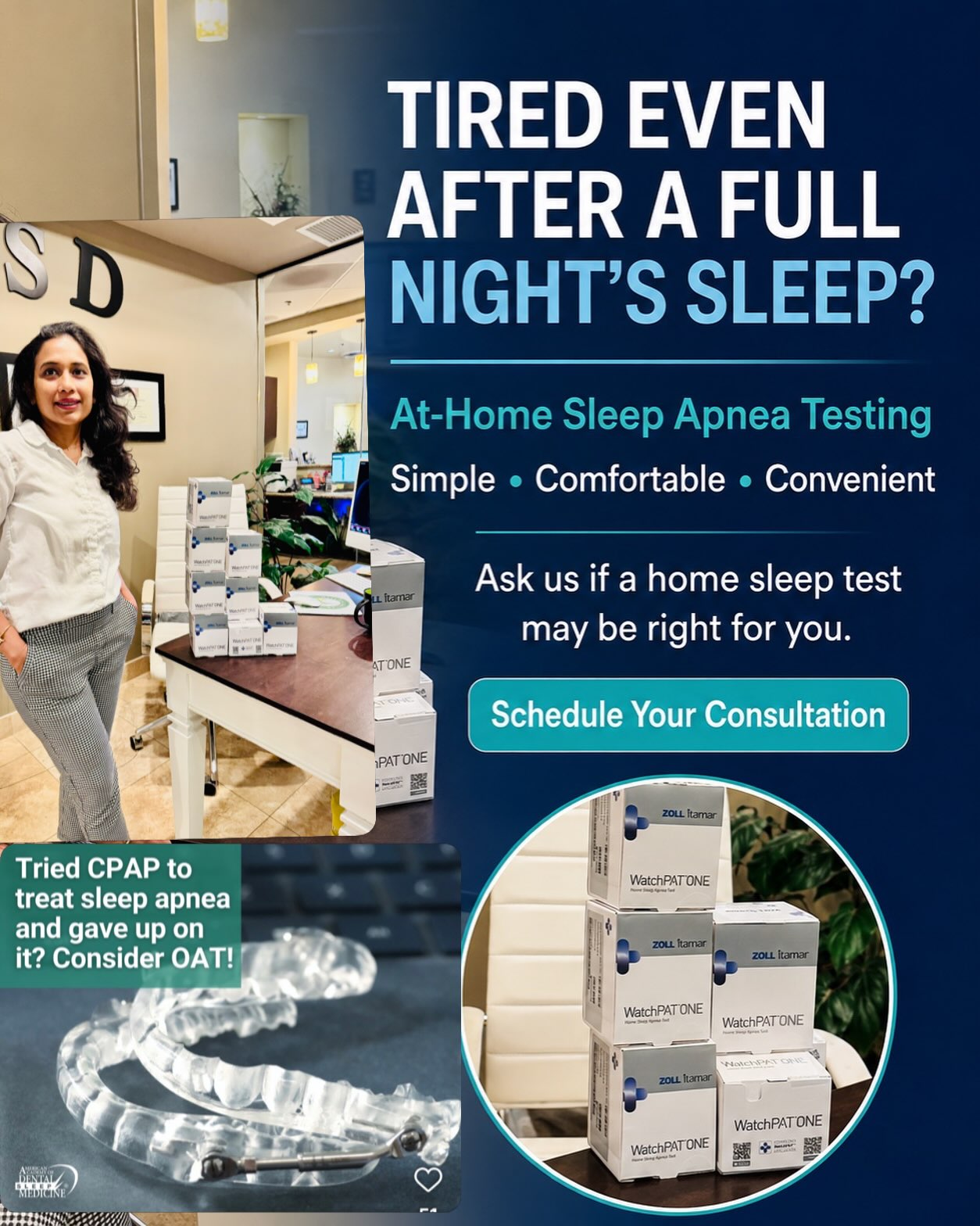
- If your dental exam suggests airway concerns and your STOP-BANG flags moderate-to-high risk, we can fit you with a small home sleep test (HST) the same day. It's a finger-tip oximeter plus a chest sensor — no wires, no hospital, no overnight clinic stay. You wear it for one to three nights in your own bed.
- The HST sends its overnight data back to us. The recordings are interpreted by a board-certified sleep physician we partner with, and you get a written diagnosis (or a clean all-clear) within a few days.
- We review the results with you at a follow-up visit and lay out the treatment paths that fit your case.
For uncomplicated mild-to-moderate cases that turn out to be a clean fit for dental sleep medicine, we can handle the whole path in-office. For more severe cases — apnea-hypopnea index over 30, oxygen desaturation below 80%, or significant cardiac history — we coordinate directly with a sleep-medicine physician for CPAP titration. Either way, you don't have to figure out the next step on your own.
If the test confirms apnea — your treatment options
There are three workable paths. None of them is universally "best" — the right answer depends on your apnea severity, your anatomy, and what you'll actually use every night.
- Custom oral appliance therapy. For mild-to-moderate apnea (and for moderate-to-severe cases where CPAP intolerance is documented), a small custom appliance that gently advances the lower jaw at night can hold the airway open without machinery. We take an iTero scan, send the design to a dental sleep lab, and seat the finished appliance two to three weeks later. Most patients adapt within a week. There's no mask, no hose, no white noise. It travels in a carry-on.
- CPAP — continuous positive airway pressure. The gold standard for severe sleep apnea. A small machine pushes a gentle stream of air through a mask to keep the airway open. Effective when worn — but compliance is the hard part. Studies put long-term CPAP adherence somewhere between 30% and 60%. If you've already tried CPAP and couldn't tolerate it, an oral appliance is often the right backup.
- Combined or alternating therapy. Some patients use CPAP at home and an oral appliance when they travel. Others use the appliance year-round and CPAP only during illness or weight gain. We're flexible — the appliance is yours, the data we collect at follow-up tells us whether your current strategy is working.
Why this matters more for Sun Lakes patients over 55
Obstructive sleep apnea becomes substantially more common after age 50, and the prevalence in adults over 65 is estimated at roughly 25% to 35% — about three times the general-adult rate. In a community like Sun Lakes, where many of our patients are in their 60s, 70s, and beyond, snoring and disrupted sleep tend to get written off as a normal part of getting older. They usually aren't. Treating obstructive sleep apnea can lower blood pressure, reduce daytime sleepiness, sharpen short-term memory, and protect the teeth from years of grinding-related wear we'd otherwise have to rebuild with crowns, onlays, and night guards. It's also one of the modifiable risk factors for atrial fibrillation — a topic that comes up a lot in our 65+ patients.
See our Sun Lakes dentist page for the in-office service summary and the booking link for a screening at your next exam.
Insurance and cost in 2026
Sleep apnea testing and oral appliance therapy are typically billed under medical insurance, not dental — even though they're delivered at a dental office. That's good news for most of our Chandler and Sun Lakes patients because the deductibles and coverage on the medical side are usually far better than the modest annual maximums on a dental plan. Medicare Part B covers sleep apnea diagnosis and oral appliance therapy with prior authorization when criteria are met, and most major medical plans (BCBS, United, Aetna, Cigna, Humana) follow similar criteria. Out-of-pocket cost for a home sleep test in Chandler in 2026 is usually $150–$400 if billed cash, and oral appliance therapy is usually $1,800–$3,500 cash if not covered. Our front desk runs a benefits check before any device is ordered so you know the number in writing.
Ready to schedule a screening
If you've been told you snore, or you wake up unrested, or you've been pushed away from CPAP and never followed up, ask about a sleep apnea screening at your next visit. New patients can book a screening alongside their first exam. Existing patients can add it to a hygiene visit you already have on the books. As always, the goal at our Chandler dentist office is to keep the answer simple, the math honest, and the next step obvious.
Screening for sleep apnea is one of several in-office services we've layered onto a standard Chandler family dentist visit — alongside same-day CEREC crowns, AI X-rays, 3D CBCT imaging, and the rest of the in-office tech detailed on our About page. One office, one care plan, one set of records.